Decaf Subscription
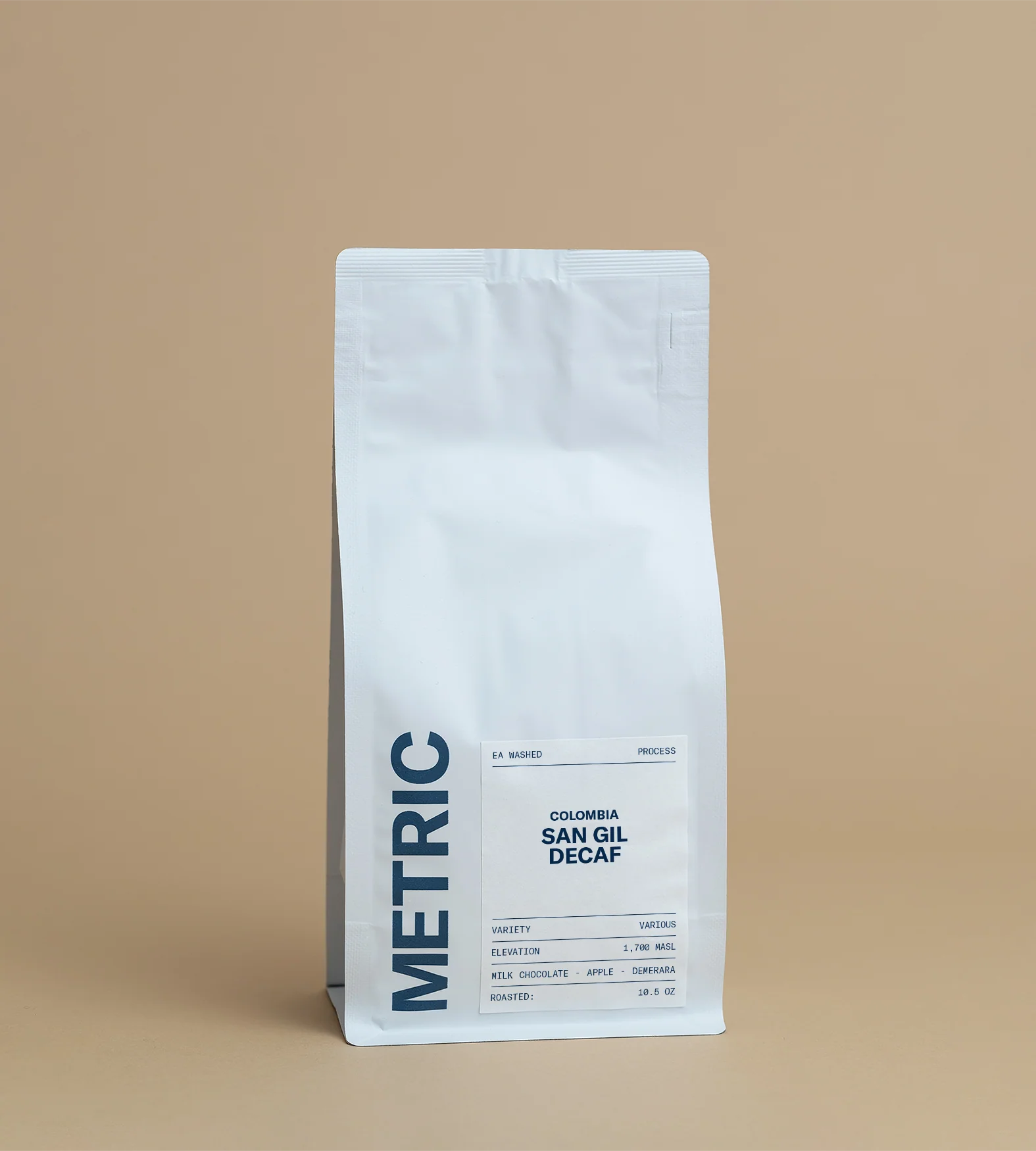
Decaf gets a bad rap, but we think it shouldn’t. At Metric, we see decaf as the result of intention, care, and craft—not compromise.
Grown in the storied highlands of Colombia— Located in the North-East of the country, coffee grown in the San Gil area of Santander is done so at slightly lower altitude and higher temperatures than the rest of Colombia. The warmer conditions require coffee to be grown under heavy shade, often up to 100% shade.
The process for decaffeination begins with sugar cane, grown on the outskirts of the town of Manizales, Caldas in Colombia. The sugar cane is turned into molasses, fermented to create ethanol and processed with acetic acid to create the ethyl acetate that will be used in the extraction of caffeine. It is put in tanks where the coffee is steamed and introduced to hot water to open up the structure of the coffee. Once ready, the EA solution is introduced to the coffee and run through multiple times. During this process, the caffeine bonds with the ethyl acetate and is ultimately separated from the coffee, removing a minimum of 97% of the caffeine. After the extraction of caffeine, the coffee is steamed once again to remove any traces of the ethyl acetate, and then sent to dryers to return the coffee's moisture content near to its beginning value. Once dried, the coffee has a light food grade safe wax coating applied to it that is integral to protecting the coffee and increasing shelf stability.
*FREE SHIPPING ON ALL SUBSCRIPTION ORDERS.
Original: $27.00
-65%$27.00
$9.45Product Information
Product Information
Shipping & Returns
Shipping & Returns
Description
Decaf gets a bad rap, but we think it shouldn’t. At Metric, we see decaf as the result of intention, care, and craft—not compromise.
Grown in the storied highlands of Colombia— Located in the North-East of the country, coffee grown in the San Gil area of Santander is done so at slightly lower altitude and higher temperatures than the rest of Colombia. The warmer conditions require coffee to be grown under heavy shade, often up to 100% shade.
The process for decaffeination begins with sugar cane, grown on the outskirts of the town of Manizales, Caldas in Colombia. The sugar cane is turned into molasses, fermented to create ethanol and processed with acetic acid to create the ethyl acetate that will be used in the extraction of caffeine. It is put in tanks where the coffee is steamed and introduced to hot water to open up the structure of the coffee. Once ready, the EA solution is introduced to the coffee and run through multiple times. During this process, the caffeine bonds with the ethyl acetate and is ultimately separated from the coffee, removing a minimum of 97% of the caffeine. After the extraction of caffeine, the coffee is steamed once again to remove any traces of the ethyl acetate, and then sent to dryers to return the coffee's moisture content near to its beginning value. Once dried, the coffee has a light food grade safe wax coating applied to it that is integral to protecting the coffee and increasing shelf stability.
*FREE SHIPPING ON ALL SUBSCRIPTION ORDERS.